

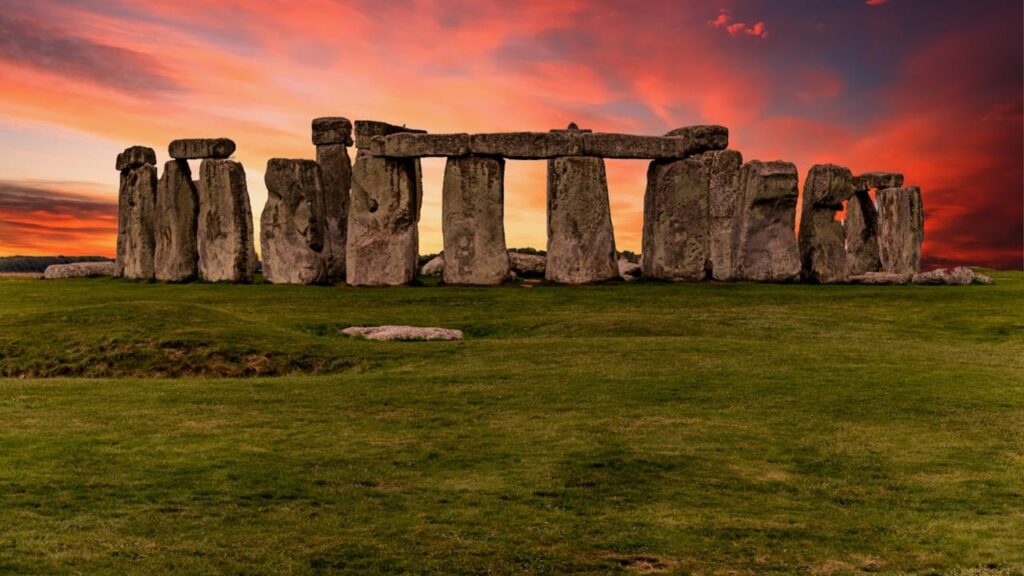
One way to add depth to a TTRPG world is by giving it a sense of time. The easiest way to do this is by evolving locations. Places change ownership and usage; people tend to add to, or build over, existing structures instead of erasing them. By leaving traces of the old architecture and traditions, it’s much easier to evoke a sense of depth. Great adventures like The Caverns of Thracia by Jennell Jacquays do this. But, some of the most recognisable real-world locations do, too; take Stonehenge.
Stonehenge: A Case Study in Evolving Locations
For these facts, I’m going to lean on the brilliant history Professor Ronald Hutton’s work. I really recommend this video for the curious—it’s his lecture “Prehistoric Gods of Britain” where Stonehenge is one of the case studies. The link is timestamped to where Stonehenge becomes the focus, but the whole video is an interesting watch. To briefly summarise, though, we know almost nothing about Stonehenge. That is, besides, in his words:
“Stonehenge could be one of the great architectural disasters of human enterprise built by cowboys, working to an overambitious plan.”
Professor Hutton is using “cowboys” in the sense of careless craftsmen. He says this because during one rebuild, when people added the giant sarsen stones, they didn’t use similar sizes. Instead of using ones of the same height, they tried using a much shorter stone. Propping it up on an underground ledge, they must have hoped the ledge and the lintel would keep it stable.
Unfortunately, it was poor design. At some point, the shorter stone slipped, dropping its lintel and smashing the centre stone. Breaking the centre stone ruined the site as a place of ritual. There was no attempt to repair the damage; the debris still lies all over the inner circle today. There is a chance this might have happened during the redesign—the site never reached completion—and the builders abandoned Stonehenge soon after.
Stongehenge As a Changing Location
Destruction included, Stonehenge is a brilliant example of a site changing with the times.
First, the hints about the builders. The stones use mortise and tenon joints; Professor Hutton describes them being planed smooth, too. These are woodworking techniques. It’s likely the builders had a lot of experience manipulating wood; then, they tried to transfer those skills into working with stone—poorly, as it turned out. However, it’s a good guess this was a new idea for the group. It’s an understandable evolution of their thinking, albeit with monumental results.
Also, ambition is obvious. The nearby Woodhenge was either a blueprint or a sister site. But wood, and all their skill and knowledge of using it, wasn’t enough. They were determined to use stone; and, they were going to move blocks of 2-4 tonnes over 140 miles (225km) to do it. For perspective, no other similar site in Europe used stones from more than 5 miles (8km) away. Even the sarsen stones, 25-30 tonnes each, came from 15 miles (24km) away.
The Evolutions of Stonehenge
However, I mentioned these came as part of a rebuild. In fact, Stonehenge changed several times. Long before the first stones arrived, the site was an important burial ground for the culture that preceded the builders. We can’t be sure if the changeover was friendly or not, but the builders definitely agreed the site was special. By building Stonehenge over the site, the builders harnessed, or repurposed, the local sacred power. The location evolved.
Later, plans for the site changed again. Perhaps the culture had also changed or the rituals evolved. They moved the bluestones into new positions—where we find them now. This was when the builders mined, smoothed, and brought the big sarsen stones. Whether trying to use mismatched stones came from inexperience, over-optimism, carelessness, or rushing, we’ll never know. Smashing the centre stone must have been a disaster. It may have felt like a judgment from greater powers. The builders abandoned the site near the end, if not in the middle, of the rebuild.
Stonehenge fell out of use long before the Romans came. In fact, the first mention of them we have in writing comes from Henry of Huntingdon in 1130. A cleric and notable historian, he said, even then, no one had any idea why Stongehenge existed.
Yet, Stonehenge still had at least one more evolution in store. Now, of course, it’s a hugely popular tourist site, which demands a visitor centre, tours, and everything else that comes with that; however, modern druids and pagans have also being repurposing it since the last century. Its place as a sacred location for ritual has been revived, particularly at the winter solstice. Its significance and usage has changed again.
Evolving Locations in the Worlds of TTRPGs
This serves as a brilliant case study in how places change with the times, cultures, and people around them. Each change offers an opportunity to impress upon players the world has depth; there’s history they can dig into if they wish. However, it’s a brave gamemaster (GM) who expects players to take that cue. One of the most common complaints I see online is GMs frustrated their players aren’t engaging with their world.
To be blunt, why should they? The history of a world, no matter how cool, intricate, or realistic, is basically fan fiction. And fan fiction rarely engages people outside of the fandom. For a homebrew world, players have no film, book, or video game to get hooked by. Their only points of reference are the snippets of information the GM gives them. Consequently, it isn’t rare for the real fandom of a homebrew setting to be the GM alone.
Making Worldbuilding Work to Engage Players
Make the information matter. However, this isn’t a gotcha designed to catch out players not taking notes. My example here is Jennell Jacquay’s The Caverns of Thracia. I’ve already covered this in some detail in this article looking at the evolution of adventure-location ecology. However, for this article I want to concentrate on one particular point:
Jennell created a location first built by lizard men, taken by one human faction, then another, and finally beastmen. Each of these groups sees different value in the caverns; they all want it, but for very different reasons. Consequently, each of them treat the place in different ways, and have changed it accordingly.
Each group has maintained the purpose of some rooms, changed others, ignored some, and walled off others. These worldbuilding details directly feed into the dungeon’s design. Differences in architecture give workable hints about the type of threats characters face, the danger levels, and the level of treasure available. The last one is particularly important because it stops history being a vicious gotcha. Instead, players can learn, for instance, the really cobwebbed, abandoned areas will often have the best (lizard men era) loot. There is a carrot along with the stick.
Evolving Locations Can Help Session & Dungeon Balance
It also gives variety to exploration. By giving the location a history of owners, there are narrative reasons why the rooms aren’t all in use. It explains why there are empty or abandoned rooms to give the players respite, allowing variable tension.
It also gives reasons to why these rooms still have treasures and clues; previous owners just didn’t search the area hard enough because they focused on other areas; or, by repurposing a room, they covered over something, creating a secret for the party to find. Both of these make exploring quieter rooms worthwhile, and loot feel more naturally placed.
This is brilliant design. It helps the real-world pacing of game sessions through the variable tension; it adds meaningful variety to encounter types and makes exploration more rewarding; and lastly, it gives players reasons to pay attention to the world’s details with mechanical benefits.
Worldbuilding with Little Value
As a counter example, let’s consider the 5e version of Curse of Strahd. In theory, there should be at least three eras. The architecture should betray the culture before the Strahd family conquered the area; the time when the family ruled fairly; and the current ruin and decay caused by Strahd and the Dark Powers’ grip on the world.
Instead, most places are nondescript medieval gothic stereotypes. Everywhere the player characters go, the buildings are dark and sagging under their own weight. The lack of variety gives no information to players. There are no clues about what they might find beyond the obvious, like a priest in a church.
True, the tone of the setting is dark and gothic, but that’s clear within the first 10 minutes of the adventure. By session 20, there’s no value in describing yet another building as dark and sagging. I love the campaign; I’d argue it’s actually 5e’s best. However, the effort put into characterising the world is a massively missed opportunity. As an aside, the TTRPG community are amazing and have created gems like this to help fill in those blanks with far more flavour.
Make Evolving Locations Work for the Group
There’s no way the majority of players will engage with every element of a homebrew world. So, it becomes vital for GMs to spotlight the coolest, most exciting, most fun parts get the spotlight. That spotlight means repeated emphasis so players can identify a pattern.
The risk of course is to push the details too hard, to force the pattern too much. It helps to remember lore-delivery is never the point of an encounter. Every encounter’s goal is just setup for the players to make a meaningful choice. That meaningful choice can challenge them tactically, narratively, or—ideally—both. It’s never a memory quiz that punishes players for not getting hooked by the lore. The pattern is there, and will help the players who identify it. However, it’s always in the background, never in focus at the expense of the PCs.
Characters can explore The Caverns of Thracia without penalty to players who just want to roll dice and relax. It’s more valuable to engage with the NPCs than take very careful note of the architecture. However, to those that enjoy the details, there’s plenty for players to dig into if they do like the lore. Additionally, there is a rock solid foundation for GMs running the adventure; it helps understanding of the adventure’s and the dungeon’s logic which makes improvising in-world responses that bit easier.
Evolving Locations Are Worldbuilding’s Secret Sauce
Evolving locations are a fantastic way to add depth to a world. They add to the immersion for players; more importantly, it gives a ready resource for GMs that helps manage tension, session pace, encounter variety, and reward management. Looking at The Caverns of Thracia and at Stonehenge, it’s hard not to see a goldmine of potential. Its their storied histories that enable that potential. It’s a brilliant blueprint to follow.
Give it some thought!


