

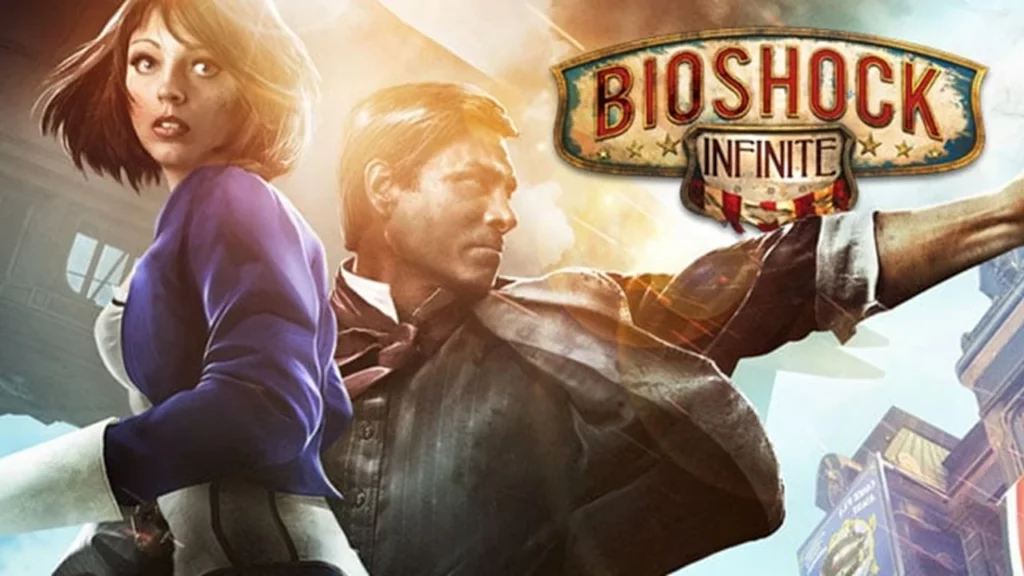
Themes in TTRPGs are a brilliant way of quickly onboarding a group into a new setting. They also help to keep narratives and a campaign cohesive. However, there is a danger of focusing too heavily on themes. It ends up battering the game into a tiny box, prioritising theme over fun. Taken too far, theme kills player agency and loses sight of the hobby’s main goal: enjoying time with friends. My use case for this is the video game Bioshock Infinite.
Shocks Rock
First, let’s get the fanboying out the way. I could gush about the Shock Series in general for weeks. System Shock, System Shock 2, Bioshock, and Bioshock Infinite present a fascinating snapshot of the evolution in first-person shooter storytelling.
They pioneered many things that have become industry standards. Adventure-locations suddenly started making sense (much like The Caverns of Thracia in TTRPG history); players received hints and objectives through audio messages mid-mission. Many of their innovations seem so natural now, but it was the Shock games that did them first.
A Shortcut For Immersion
Before I cut loose, I want to be clear I think the Shock games are great examples of how effective using themes can be. Right from the menu screens—the fonts, the art styles, music, or ambiences—players are instantly onboard with each setting. System Shock 2 is cold, brutal, and menacing. Bioshock is darkness, 1950s glam, and tragic piano notes. Infinite is overly bright and shining, but cannot hide its violence and decay.
All of this works to immerse the player in very different worlds. However, the games go further; they challenge the player with themes and ideas far above most other franchises in existence.
Industry Shock
The very first System Shock launched back in 1994. Developed by Looking Glass Studios, it was already trying to be different from the competition. Doom, Quake, and Wolfenstein 3d were fun, but you could summarise their stories in a sentence. They never tried to hit players with powerful, thought-provoking questions. The boomer shooters were a challenge of reflexes, nothing more. And that’s fine, because that’s all they wanted to be. Shock, though, wanted to be different. It wanted to use complex themes.
Shock dived deep into cyberpunk tradition. While Gary Gygax and Dave Arnesen were evolving Chainmail into some newfangled game called Dungeons & Dragons, cyberpunk was born. Shock explores many of the genre’s main themes. Sure, the game tested a player’s reflexes. However, it also wanted to explore the cost of corporate greed, unchecked pride, and the potential horror of AI without limits.
Enter SHODAN
You—the hacker has no name and the other characters address you directly; the latter is a simple technique many GMs use to nudge players into a PC’s mind; the game pulls the same trick—you wake up on a space station, and everyone is dead. It’s also [partly] your fault. It was you that removed the space station AI’s ethical restraints. You let SHODAN off the leash, and now she has taken over the station. However, her ambitions go far, far further:
In my talons, I shape clay, crafting life forms as I please. If I wish, I can smash it all. Around me is a burgeoning empire of steel. From my throne room, lines of power careen into the skies of Earth. My whims will become lightning bolts that raze the mounds of humanity. Out of the chaos, they will run and whimper, praying for me to end their tedious anarchy. I am drunk with this vision. God: the title suits me well.
A lot of the writing is fantastic, and it’s brilliantly voiced by Terri Brosius. Terri’s performances and the writing have kept SHODAN in consideration as one of the greatest villains in video games of all time.
As the hacker, you will fight zombies, robots, and cyborgs. The cyborgs are particularly relevant because they re-frame the Theseus’ ship problem; if you replace enough body parts with cybernetics, does a person stop being human? Where is the line between human and machine? I had a lot of fun with Doom and the others, but Shock’s ambition was on another level.
Leveling Up
With development of System Shock 2, Ken Levine and Irrational Games come into the picture. Irrational would co-release Shock 2 with Looking Glass before going on to create the Bioshocks alone. With Ken as lead writer, Shock 2 had an art major at the helm, not a programming wizard. Shock 1 had limited its themes to ones common to the cyberpunk genre. With Ken on board, its successors looked further, and went harder.
Shock 2 would look at the threat of technology, of hopelessness and human fragility. Bioshock explores a form of Ayn Rand’s objectivism, free will versus determinism, class inequality, addiction, and self-destruction. Infinite focuses on American exceptionalism, class struggle (again), racism, determinism (again), redemption, and guilt. The series remains unique in the industry just for the amount and depth of complex themes it tackles.
With each of these, the player finds NPC audio logs, or sees events and consequences unfold that give contrasting perspectives. The game takes a theme and forms a question, but there is never a simple answer to it. Each side—sometimes there are more than two—are understandable even if they are not agreeable. The NPCs’ emotions and history make their views feel believable. Then, it’s on the player to find an answer by themselves. Sometimes there is no satisfactory answer. Themes should offer powerful questions, not force certain answers.
Who Are You?
Before I pitch where Infinite goes wrong, I want to give an example of the Shock series using theme well. One central theme running through System Shock 2 to Bioshock Infinite is identity. The original Bioshock is the most brilliant at this, but it’s impossible to talk about that without massive spoilers. Instead, I’ll switch to Shock 2.
In the first game, leaving the hacker anonymous was more of a gimmick. Shock 2 puts the player—another [nearly] nameless hacker—between The Many and SHODAN.
The Many are a hivemind zombie force that twists religious fanaticism from a search for transcendence into digestion. Anyone who refuses to “join their choir” becomes food. The Many want you to join in their joyful song. Give up your sense of self and gain enlightenment.
Conversely, SHODAN also sees the hacker’s independence as disgusting, but from the other end of the spectrum. Whereas The Many represent pure equality through destruction of the self, SHODAN believes her power so vast, anything else’s identity is meaningless. All life is hers to create, change, and destroy at any given moment. Give up your sense of self and submit to the new god.
There is also a third side: the humans who died fighting The Many, or are desperately trying to escape. Sometimes banal, often tragic, these are human stories about fear, anger, acceptance, hope, and love. They are not trying to persuade the hacker—pretty much all of them don’t even know you’re alive; they’re just people trying to survive, but this contrast is important to ground the inhumanity of The Many and SHODAN.
Why Do You Persist?
Being outside their control, they find the hacker very confusing. Through audio, they voice this confusion often. They ask you who you really are; they question your motivations. How can you continue in the face of such undeniable logic? It’s incomprehensible to them, but they will get no answers.
In a trick Bioshock would copy, Shock 2 gives the hacker just one line of audio in the whole game. It weaponises the protagonist’s silence to keep their enemies guessing; it keeps the player guessing, too. Is the hacker just trying to survive? Are they fighting for a just cause? Is it ambition? Is it revenge? Again, strong themes provide questions; they don’t force answers.
When Theme Hurts The Fun
I hope it’s clear I believe the Shock games take on complex themes and deliver them well. However it’s now we come to the inevitable but. Bioshock Infinite is a cautionary tale to GMs and players wanting to push theme too hard.
One of the major themes of Infinite is the question: if two choices lead to the same conclusion, does the choice even matter? Constants and variables. Small things change, but end results are always the same. The player’s character can choose heads or tails on a coin toss; he can choose a necklace with a bird motif or one with a cage; he can choose to confront a suspicious clerk or be patient. It doesn’t really matter. The coin toss will always be heads; both the bird and cage are symbols of Elizabeth’s imprisonment; the clerk scene always ends in a fight.
This may seem like I am shaping up to attack railroading here, but not this time. True, this is very much a case of false choices and quantum ogres. The players aren’t building a story with the GM, they’re receiving a lesson.
Collateral Damage
It also risks ruining NPCs. In some ways, Comstock is arguably less a character than a representation of zealotry; Daisy Fitzroy does little more than put a face to revolutionary extremism. They aren’t characters; they’re arguments to hammer home a message. There’s no interesting contradiction or complex motivation to dig into. Good NPCs—and good factions too—have messy, human goals that evolve over time. Those motivations come organically from emotional responses and events in the NPC’s past.
Losing Sight Of The Fun
However, I’d actually pitch Infinite does something worse than railroading. Here, I’ve argued a certain amount of railroading is necessary for an epic conclusion to a story. And Infinite—with its two expansions—delivers a truly incredible conclusion. It’s actually the bigger error is in its level design.
Many of the maps have two long paths reaching the same point. Ken’s never gone on record, but it seems certain his team made a false assumption. They seem to have thought players would pick one route and carry on to the next map. The game’s pacing relies on this.
In fact, what actually happens is many players go back and explore both paths, making sure they don’t miss anything. This means they get to the finish point, go back to the start, and then return to the finish the other way. These paths are not short, the player character isn’t fast, and the payoff is minimal. It turns these sections into a slog.
But Infinite actually makes things worse by including occasional secrets and collectables. Now, these are almost never in a section split by two paths. Almost. Inexperienced players are unlikely to notice this fact, however, and it happens enough to make players think “what if”. Many negative reviews focus on the pointless tracking backwards and forwards in these areas.
Critical Error
I will happily argue Infinite is a great game, but this was a poor design choice. Theme somehow became more important than player experience. How might this have happened? Sometimes people fall in love with clever ideas and forget what really counts.
Sometimes, we get protective of those ideas. At that point in TTRPGs, player agency starts to feel like a risk; if the players go off-course, it might weaken the adventure theme. The setting may collapse. In reality, if a theme cannot survive player agency, then it was too weak to begin with.
A Theme In TTRPGs: Grim, Grim, Grim
I once played in a short Fate Accelerated adventure as a player. The setting was a sci-fi dystopia where everything was either a vampire or vampire food. The setting was grim. The NPCs were grim. The story was grim.
The fun faded fast.
The party never met a NPC enjoying life. No one had any hope. In some ways, the worldbuilding was fantastic and the details very clever. But it was uniformly grim. It’s contradictions and exceptions that make theme a strong.
Poorly Chosen Themes
Interesting themes are not statements. “What will it cost to fight tyranny?” is better than “tyranny is bad.” The latter has no variable answer for players to dig into. It’s obvious and uninteresting.
Travel mechanics that do nothing but tax the party to highlight the region is rough are poor. Travel should have benefits, and possible rewards. I go into more detail on that here; however, a quick shout-out to Land of Eem which covers its map with loads of ingredients and reagents for crafting.
Setting Up A Strong Theme in TTRPGs
Groups agreeing themes in a session zero are fine. However, for real engagement, players need to encounter situations and NPCs that show, don’t tell. For instance, in an adventure focused on the cost of tyranny, have the players meet NPCs that actively fight it. They want bloodthirsty revenge, noble justice, equality, or power for themselves.
Equally important are NPCs that have benefited from it. Their lives are safer, resources are constant, they have gotten power, it satisfies a bloodthirsty nature.
The NPCs and the environment should promote the good and bad from all sides. Then, the players should have the space to come to their own answers. This might mean breaking a power structure, reforming it, or escaping it completely.
If the wilds are dangerous and unforgiving, still have potential rewards for characters that go exploring. Someone, somewhere, will have figured out how to turn the hardship into an advantage. Exceptions—like a single oasis—or contradictions—the land is safe from midnight till 2am—invite questions and adventure seeds. Without exceptions or contradictions, there’s no space for the group to invent and evolve. Perfection is the enemy of creativity, fun, and great themes.
A Theme in TTRPGs Should Serve The Fun, Not Break It
Themes are definitely something to consider for an adventure with a narrative focus. However, they should never get in the way of the experience and fun at the table. Going too hard on themes turns a game into a lesson. Make questions, don’t preach.


